vLLM vs TGI vs SGLang for LLM Serving on GPU Rentals in 2026
vLLM for throughput-default; TGI for Hugging Face shops; SGLang for structured output. Pick by inference workload shape, not raw benchmarks.
The three LLM serving engines compared. Vendor docs linked above.
The bottom line
For a dev team self-hosting an open-source LLM on a rented GPU in 2026, three serving engines compete: vLLM, TGI (Text Generation Inference, from Hugging Face), and SGLang. All three are open-source, run on commodity NVIDIA GPUs, and ship rapid releases. The choice is not “which one works.” Each does. The choice is which one’s defaults match the workload shape.
Pick vLLM if throughput is the bottleneck and the workload looks like high-concurrency batch inference: chat APIs, retrieval-augmented generation, multi-tenant LLM gateways. vLLM’s PagedAttention 1 popularised efficient KV-cache memory management and remains the throughput-focused default for the open-source LLM-serving category 2 . The community is the largest, the model-support catalogue is the broadest, and the production-deployment stories are the most documented.
Pick TGI if the team’s stack centres on the Hugging Face ecosystem. TGI 3 is the serving engine Hugging Face ships and runs on its own Inference Endpoints product. The integration with the Hub (model loading, tokeniser handling, safetensors weights, gated-model auth) is tighter than vLLM’s or SGLang’s because TGI is the same team’s product. For shops where the engineering reflex is “find it on the Hub, deploy it from the Hub,” TGI removes integration friction the other two engines impose.
Pick SGLang if the bottleneck is structured output. SGLang’s RadixAttention 4 and its frontend language for structured generation (regex-constrained decoding, JSON schema enforcement, function-calling, multi-turn programs) are the framework’s centre of gravity, not bolted-on features. For teams whose product is “extract this JSON from a corpus” or “the model must always emit valid function calls,” SGLang’s structured-decoding surface earns its keep at the constraint-handling level.
Skip all three only if the deployment scale is small enough (single-user tooling, occasional inference, no real concurrency) that a single transformers Python script on a laptop GPU does the job. For that scale, the serving abstraction is overhead rather than payoff.
What each engine actually is
The three projects share an ancestry. All started as research efforts to make LLM inference cheaper on a fixed GPU budget, and have diverged sharply in 2024 to 2026. The cleanest way to understand the difference is to look at what each project’s documentation surfaces first.
vLLM leads with PagedAttention and continuous batching 1 . The mental model is that LLM inference wastes GPU memory when sequences of different lengths share a fixed-size KV cache, and that paginating the KV cache (the way virtual memory paginates RAM) lets the engine pack more concurrent requests onto the same GPU. The framework’s expansion areas across 2024 and 2026 (speculative decoding, tensor parallelism, prefix caching, expanded quantisation support) all extend the throughput-per-GPU surface 2 .
TGI leads with production-ready inference for Hugging Face Hub models 3 . The mental model is that a Hub model card describes a model fully (weights, tokeniser, generation defaults, chat template), and a serving engine should consume that description and start serving with minimal configuration. TGI’s expansion areas (the OpenAI-compatible Messages API, Tools / function-calling support, the Hub-native deployment story on Inference Endpoints) all extend the “deploy from the Hub” surface 5 .
SGLang leads with RadixAttention and structured generation 4 . The mental model is two-layered. Below, a serving runtime that shares prefix KV-cache aggressively across requests using a radix tree (overlapping prompts pay only for their unique suffix). Above, a frontend language that lets the developer express structured generation (JSON, regex, multi-turn, control flow) as a Python program the runtime then executes efficiently 6 . The expansion areas (function calling, tool use, vision-language model support, RLHF integration) all extend the structured-output surface 6 .
A practical signal: read each project’s “first tutorial.” vLLM’s quickstart asks the developer to pip install vllm, then start a Python interpreter and call LLM(...).generate(...) on a prompt list 1 . TGI’s quickstart asks the developer to run docker run with a Hub model name and curl the resulting OpenAI-compatible endpoint 3 . SGLang’s quickstart asks the developer to launch a server, then write a Python program with @sgl.function decorators and gen() calls that the runtime executes 6 . The first thing each project wants you to build is the centre of its design.
At a glance: the comparison table
| Axis | vLLM | TGI | SGLang |
|---|---|---|---|
| Primary use case | High-throughput batch inference; multi-tenant LLM gateways | Hugging Face Hub model deployment; OpenAI-compatible API | Structured output: JSON, function calls, regex-constrained decoding |
| Core innovation | PagedAttention (KV-cache paging) | Hub-native deployment + production hardening | RadixAttention (prefix-shared KV-cache via radix tree) |
| Throughput on chat workloads | Throughput-focused default; competitive on most benchmarks | Strong throughput; close to vLLM on most chat workloads | Competitive throughput; meaningfully ahead when prompts share prefixes |
| Structured-output support | Outlines / guided decoding via integrations; not first-class | JSON schema + Tools API on the OpenAI-compatible surface | First-class regex / JSON / function-calling in the frontend language |
| Model-support catalogue | Broadest: Llama, Qwen, Mistral, DeepSeek, Gemma, and many more | Broad: Hub-listed text-generation models, plus vision-language | Broad: most major open-weight families plus VLM and embedding |
| Quantisation | AWQ, GPTQ, FP8, INT8, INT4 via integrations | AWQ, GPTQ, EETQ, FP8 with auto-detection from Hub model cards | AWQ, GPTQ, FP8, native FP8 KV-cache support |
| Multi-LoRA serving | First-class: multi-LoRA in production with hot-swap | Supported via dynamic adapter loading | Supported; growing surface |
| GPU compatibility | Runs on any CUDA-capable GPU rentable in India (A10, A100, H100, L4, RTX 4090) | Runs on the same; tightest fit for users already deploying via Hub | Runs on the same; AMD ROCm support on MI300/MI355 plus native TPU execution via the SGLang-Jax backend |
| Docs quality | Comprehensive but sprawling; multiple paths through similar topics | Tighter; OpenAI-compatible flow is the canonical narrative | Tight on the structured-output flow; smaller surface area |
| Community / GitHub stars (rough signal) | Largest in the open-source LLM-serving category | Top three; Hugging Face brand pulls strong adoption | Growing fast; smaller community than vLLM, larger than most peers |
| Best fit | Teams whose load is throughput-bound chat / RAG / batch inference | Teams already deploying via Hugging Face Hub or Inference Endpoints | Teams whose product is structured output: JSON, function calls, regex constraints |
- Primary use case
- High-throughput batch inference; multi-tenant LLM gateways
- Core innovation
- PagedAttention (KV-cache paging)
- Throughput on chat workloads
- Throughput-focused default; competitive on most benchmarks
- Structured-output support
- Outlines / guided decoding via integrations; not first-class
- Model-support catalogue
- Broadest: Llama, Qwen, Mistral, DeepSeek, Gemma, and many more
- Quantisation
- AWQ, GPTQ, FP8, INT8, INT4 via integrations
- Multi-LoRA serving
- First-class: multi-LoRA in production with hot-swap
- GPU compatibility
- Runs on any CUDA-capable GPU rentable in India (A10, A100, H100, L4, RTX 4090)
- Docs quality
- Comprehensive but sprawling; multiple paths through similar topics
- Community / GitHub stars (rough signal)
- Largest in the open-source LLM-serving category
- Best fit
- Teams whose load is throughput-bound chat / RAG / batch inference
- Primary use case
- Hugging Face Hub model deployment; OpenAI-compatible API
- Core innovation
- Hub-native deployment + production hardening
- Throughput on chat workloads
- Strong throughput; close to vLLM on most chat workloads
- Structured-output support
- JSON schema + Tools API on the OpenAI-compatible surface
- Model-support catalogue
- Broad: Hub-listed text-generation models, plus vision-language
- Quantisation
- AWQ, GPTQ, EETQ, FP8 with auto-detection from Hub model cards
- Multi-LoRA serving
- Supported via dynamic adapter loading
- GPU compatibility
- Runs on the same; tightest fit for users already deploying via Hub
- Docs quality
- Tighter; OpenAI-compatible flow is the canonical narrative
- Community / GitHub stars (rough signal)
- Top three; Hugging Face brand pulls strong adoption
- Best fit
- Teams already deploying via Hugging Face Hub or Inference Endpoints
- Primary use case
- Structured output: JSON, function calls, regex-constrained decoding
- Core innovation
- RadixAttention (prefix-shared KV-cache via radix tree)
- Throughput on chat workloads
- Competitive throughput; meaningfully ahead when prompts share prefixes
- Structured-output support
- First-class regex / JSON / function-calling in the frontend language
- Model-support catalogue
- Broad: most major open-weight families plus VLM and embedding
- Quantisation
- AWQ, GPTQ, FP8, native FP8 KV-cache support
- Multi-LoRA serving
- Supported; growing surface
- GPU compatibility
- Runs on the same; AMD ROCm support on MI300/MI355 plus native TPU execution via the SGLang-Jax backend
- Docs quality
- Tight on the structured-output flow; smaller surface area
- Community / GitHub stars (rough signal)
- Growing fast; smaller community than vLLM, larger than most peers
- Best fit
- Teams whose product is structured output: JSON, function calls, regex constraints
Pick vLLM — for throughput-bound batch inference
vLLM in 2026 is the open-source LLM-serving project with the broadest community and the most documented production deployment stories. The project ships under the vllm-project/vllm GitHub organisation 2 and has expanded from its 2023 PagedAttention origins 7 into a serving engine that supports tensor parallelism, pipeline parallelism, speculative decoding, prefix caching, and a full OpenAI-compatible API surface. The engine runs on any CUDA-capable NVIDIA GPU available on Indian cloud rentals (A10, A100, H100, L4, RTX 4090 on workstations).
For a dev team building, say, an internal RAG service that handles a few thousand queries an hour from a few hundred concurrent users, vLLM’s strength is that the engine extracts more tokens per second from the same GPU than a naive transformers deployment by a wide margin 1 . PagedAttention pages the KV cache so unused capacity goes to other concurrent requests; continuous batching schedules new requests as soon as old ones complete a step rather than waiting for batch boundaries. The combined effect on a chat workload with variable response lengths is the difference between a single A10 GPU saturating in the low tens of concurrent requests versus several times that.
The trade-off is configuration breadth. vLLM has more flags, more deployment paths, more tensor-parallel-vs-pipeline-parallel-vs-quantisation matrix combinations than TGI or SGLang. The framework has stabilised significantly through the v0.x maturation and into 2026 release cycles, but a team approaching it for the first time should expect to spend a day reading the deployment documentation and tuning the right flags for the target workload 2 . The reward is meaningful: a tuned vLLM deployment outperforms most other options on chat throughput.
vLLM’s structured-output story is via integrations. The engine supports Outlines, lm-format-enforcer, and similar libraries that constrain decoding to a grammar or schema, but the integration is a side surface rather than a first-class concern 2 . For workloads where structured output is occasional, this is fine. For workloads where the model must always emit valid JSON or always call a function correctly, SGLang’s first-class structured surface is a tighter fit.
For Indian developers, two practical notes. First, vLLM is open-source under Apache 2.0 license 2 and runs entirely on the team’s infrastructure. There is no SaaS dependency, no USD billing, no forex friction at the serving-engine layer. Second, the GPU rental is the cost line that matters: an A100 80GB on Indian cloud providers (E2E Networks, Yotta, NxtGen) in 2026 sits in the ₹125–₹250 per hour range (approximately $1.50–$3.00 USD/hour at 2026-05-19 reference rates of $1 ≈ ₹85; FX fluctuates) depending on commitment (with spot instances lower); comparable A100 80GB on-demand pricing on AWS US-East / EU-West (p4de.24xlarge fractional) and Google Cloud (a2-highgpu-1g) sits in a different commercial band and is region-dependent; verify the live vendor pricing page. vLLM’s job either way is to make every rented hour pay for as many tokens as possible.
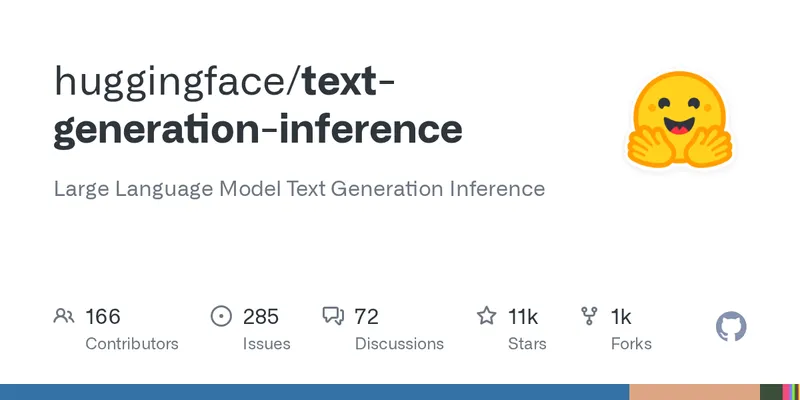
Image: Hugging Face TGI documentation (huggingface.co/docs/text-generation-inference), used for editorial coverage of the LLM serving engine compared in this guide.
Pick TGI — when the Hugging Face Hub is the source of truth
TGI’s value proposition is concentrated. The project ships under the huggingface/text-generation-inference GitHub organisation 5 and is structured around the assumption that a Hugging Face Hub model card is the canonical description of a model. Point TGI at a Hub model name, give it the GPU, and the engine reads the model’s tokeniser config, generation defaults, chat template, and quantisation hints from the Hub and starts serving 3 .
For a team building, say, an internal product that fine-tunes an open-source 7B model and ships it to its own customers, the Hub-native flow pays off. The fine-tuned model lives on the Hub (private or public), the team’s CI builds and pushes new versions, and TGI’s deployment reads from the Hub on each restart. The “deploy a new model version” step is “push to the Hub plus restart the container.” For shops where the engineering reflex is already “if it’s not on the Hub, find it on the Hub,” TGI removes integration friction the other two engines impose. vLLM and SGLang both load Hub models, but neither team’s product treats the Hub as a first-class citizen the way TGI does.
The OpenAI-compatible surface is a second area where TGI’s design clarity shows 3 . The Messages API matches the OpenAI Chat Completions shape; Tools (function calling) match OpenAI’s tool-calling shape; the JSON schema enforcement on the response works through the standard response_format parameter. For a team migrating from an OpenAI-API-shaped client codebase to a self-hosted equivalent, TGI’s surface drops in with minimal client changes.
What TGI deliberately does less of is the more exotic deployment topology surface. Tensor parallelism, multi-LoRA hot-swap, and similar features exist but the documentation density is on the “deploy a Hub model and serve it” flow rather than on multi-axis production-tuning. For most workloads this is a feature: less to learn, less to ignore, defaults that work. For workloads that demand fine-grained throughput tuning across a multi-GPU pod, vLLM’s documentation density is more useful.
The Indian-developer practical notes mirror vLLM’s. TGI is currently open-source under Apache 2.0 license 5 (reverted in 2024 from a brief HFOIL-licensed period in v1.x) and runs on the team’s infrastructure with no USD billing at the serving-engine layer. Hugging Face’s separate Inference Endpoints product is a USD-billed managed-hosting service 3 with the same forex-plus-GST friction as any USD developer tool, but that is a separate decision from the open-source TGI library, which is free.
Pick SGLang — when structured output is the load-bearing problem
SGLang sits in a different conceptual category from vLLM and TGI. The framework ships under the sgl-project/sglang GitHub organisation 6 and its design has two layers: a high-throughput serving runtime, and a frontend language for expressing structured generation as a Python program 8 . RadixAttention is the runtime’s centre of gravity 4 : prefix-overlapping requests share KV-cache state efficiently because the cache is organised as a radix tree, and a new request with an overlapping prefix pays only for its unique suffix tokens.
The structured-generation surface is what differentiates the framework. SGLang ships first-class support for regex-constrained decoding, JSON schema enforcement, function calls, control flow, and multi-turn programs 6 . The frontend language uses Python decorators and primitives (gen(), select(), regex(), + "constant text") to express the program; the runtime then executes it efficiently against the underlying model. For a team building, say, a structured-extraction pipeline that pulls typed JSON from thousands of documents, SGLang’s structured-output guarantees show up at the constraint-handling level rather than in post-hoc parsing-and-retry logic.
A concrete example of where this matters: a function-calling pipeline where the model must emit a valid call from a fixed list of available tools, with arguments matching the right schema. With vLLM or TGI, the team writes prompts and parsers and retries on schema-validation failures. With SGLang, the framework constrains the decoder to only emit valid tokens at each step, so the output is correct by construction 4 . The difference shows up at scale: a 99 per cent JSON-validity rate becomes 100 per cent, and the validation-and-retry overhead disappears.
What SGLang does less of, by deliberate design choice, is treat the generic chat endpoint as the centre of the surface. SGLang ships an OpenAI-compatible endpoint 6 and works fine as a chat backend, but the documentation density is on structured generation rather than on tuning a multi-tenant chat gateway. For a team whose workload is mostly free-form chat with occasional structured outputs, vLLM’s defaults match the work. For a team whose workload is mostly structured outputs with occasional free-form generation, SGLang’s defaults match.
SGLang is open-source under Apache 2.0 license 6 and runs on the team’s infrastructure. The community is smaller than vLLM’s but growing fast. The project’s expansion areas (vision-language model support, RLHF integration, AMD ROCm support on MI300/MI355, and native TPU execution via the SGLang-Jax backend) put it among the most active in the open-source LLM-serving category in 2026 6 .

Image: SGLang documentation (docs.sglang.ai), used for editorial coverage of the LLM serving engine compared in this guide.
How to choose
Three questions narrow the decision.
One. What is the workload shape? If the load is high-concurrency chat or RAG with mostly free-form output, vLLM’s defaults match the work and the throughput characteristics are the most documented. If the load is structured-output heavy (JSON extraction, function calling, regex-constrained generation), SGLang’s first-class surface earns its keep. If the load is moderate-volume Hub-model deployment with OpenAI-compatible client integration, TGI removes friction the other two impose.
Two. Where does the model live? If the team’s models live on the Hugging Face Hub (especially private fine-tuned variants tracked through CI), TGI’s Hub-native flow is the path of least resistance. If the team treats models as files on disk or in object storage, all three engines work; the Hub integration is a wash, and the workload-shape question dominates.
Three. What is the team’s tolerance for configuration? vLLM rewards careful tuning with the highest throughput on most workloads, but it has the largest config surface. TGI rewards Hub-aligned defaults with the smallest configuration surface. SGLang sits between, with structured-generation-specific configuration that the other two do not have. A team that wants to deploy and move on usually picks TGI. Teams willing to spend a tuning budget for the last 20 per cent throughput tend to land on vLLM, and teams whose product is structured generation default to SGLang.
A fourth consideration for Indian teams specifically: GPU rental cost. An A100 80GB on Indian cloud providers in 2026 sits in the ₹125–₹250 per hour range (approximately $1.50–$3.00 USD/hour) depending on commitment (with spot instances lower); an H100 sits in the ₹450–₹700 range (approximately $5.30–$8.20 USD/hour); commodity options (A10, L4, RTX 4090) sit lower. Comparable AWS US-East / EU-West and Google Cloud on-demand rates are in a different commercial band; the engine-selection logic (vLLM, TGI, SGLang) is region-agnostic. The serving engine determines how many tokens per rented hour the GPU produces. For a workload at scale, a meaningful throughput difference between engines on the same workload is not a small number; it can be the difference between a profitable unit economics line and a loss-making one. Benchmark against the actual workload before committing.
Honest caveats
Three things readers should know before treating this comparison as settled.
First, all three projects ship at a pace that makes any specific recommendation time-sensitive. A claim about “vLLM has the broadest model support” was true through 2025, was less true in early 2026 as TGI’s coverage expanded, and may shift again in late 2026. Re-read the comparison around end-2026 when the next major release cycle has landed. The throughput numbers in particular shift release to release; any benchmark older than a quarter is approximate.
Second, the structured-output advantage SGLang offers is most pronounced when the constraint-handling load is real. For a workload where structured output happens occasionally and a JSON-schema retry loop is acceptable, the gap between SGLang and the other two narrows. The advantage shows up when 100 per cent constraint validity is a hard requirement (downstream parsers cannot tolerate errors) or when the constraint logic is complex (multi-step function calls, nested schemas, regex patterns the model otherwise gets wrong).
Third, “production-deployed” means different things to different teams. Every one of these engines has running production deployments. Each has failure modes that show up under load: out-of-memory under burst, hanging requests, model-loading races during deploy. Running any of them reliably takes the same engineering discipline: versioning, observability, evaluation harnesses, careful capacity planning. The serving-engine choice does not substitute for that discipline. A team that picks the right engine but skips capacity planning will run worse production than a team that picks the “wrong” engine and runs careful load tests against its actual workload.
For an Indian dev team in 2026, the serving-engine decision is meaningful but not the determining factor. The model choice, the GPU choice, the workload shape, and the team’s familiarity with the engine’s defaults all weigh more heavily over a 12-month deployment horizon. Pick the engine whose defaults match the work, then spend the engineering time on the load-test harness that will tell you whether the engine choice was right at the actual production scale.
How this article was made: an autonomous AI pipeline researched, drafted, fact-checked, and reviewed this piece, aggregating publicly-available information from the sources consulted below. AI (artificial intelligence) can make mistakes, so please cross-check the consulted sources before acting on anything here. Neural Tech Daily is not liable for decisions or outcomes based on this article.
Sources consulted
Cited Sources
- 1. vLLM documentation home: framework structured around PagedAttention for efficient KV-cache memory management and continuous batching for high-throughput LLM inference; OpenAI-compatible API and broad model-support catalogue. (accessed ) ↩
- 2. vLLM GitHub repository (vllm-project/vllm): largest open-source LLM-serving repository by stars; Apache 2.0 license; expansion areas across 2024 and 2026 include speculative decoding, tensor parallelism, prefix caching, and broader quantisation support. (accessed ) ↩
- 3. Hugging Face Text Generation Inference documentation: serving engine designed around Hugging Face Hub model cards; OpenAI-compatible Messages API, Tools / function-calling support; Hub-native deployment story aligns with Inference Endpoints. (accessed ) ↩
- 4. SGLang documentation home: framework with RadixAttention for prefix-shared KV-cache and a frontend language for structured generation including regex-constrained decoding, JSON schema enforcement, function-calling, and multi-turn program control flow. (accessed ) ↩
- 5. TGI GitHub repository (huggingface/text-generation-inference): Apache 2.0 license; production-grade hardening over the Hugging Face Hub deployment story; broad quantisation support including AWQ, GPTQ, EETQ, FP8 with auto-detection from Hub model cards. (accessed ) ↩
- 6. SGLang GitHub repository (sgl-project/sglang): Apache 2.0 license; growing community; roadmap covers vision-language model support, RLHF integration, broader hardware backends including AMD ROCm and TPU; OpenAI-compatible endpoint plus the structured-generation frontend language. (accessed ) ↩
- 7. PagedAttention paper (Kwon et al., 2023): "Efficient Memory Management for Large Language Model Serving with PagedAttention." Establishes vLLM's core KV-cache paging algorithm; published throughput improvements over baseline serving stacks across a range of model sizes and concurrency levels. (accessed ) ↩
- 8. SGLang paper (Zheng et al., 2023, v2 revision 2024): "SGLang: Efficient Execution of Structured Language Model Programs." Establishes the framework's two-layer design: RadixAttention runtime for prefix-shared KV-cache plus a frontend language for structured-generation programs. (accessed ) ↩
Anonymous · no cookies set