NVIDIA Blackwell GB200 2026: GPU Cloud Rental Options for AI Teams
Blackwell-class GPUs are renting on global clouds in 2026. Where to find them, how INR billing compares, and what to test first.
The bottom line
NVIDIA’s Blackwell-generation GPUs, the GB200 NVL72 rack-scale system and the standalone B200 board, are now rentable through global cloud providers in 2026. For AI teams evaluating GPU rental options with INR billing or in-region data-residency requirements, three tracks matter. E2E Networks advertises Blackwell-class capacity on its GPU catalogue with INR billing and in-region data-centre presence, useful when DPDP Act data-residency questions are live. NVIDIA DGX Cloud offers managed access on AWS, Microsoft Azure, Google Cloud, and Oracle Cloud Infrastructure with international billing. The hyperscalers themselves, including AWS P6, Google Cloud A4 / A4X, and Azure ND GB200 v6, all carry Blackwell on demand. For training-scale workloads, the regional-provider price gap versus US-billed hyperscalers is the headline; for inference, hyperscaler ergonomics and managed services often win even at a premium. Verify current rates against each provider’s pricing page before you commit, because GPU rates shift week to week.
What’s actually shipping in 2026
NVIDIA’s Blackwell platform has moved from announcement to broad availability over the past year. The reference rack-scale design is the GB200 NVL72, which links 36 Grace CPUs and 72 Blackwell GPUs as a single NVLink domain 1 . NVIDIA frames the system as built for trillion-parameter LLM training and inference, with second-generation Transformer Engine and NVLink Switch as the two architectural deltas worth tracking versus the previous Hopper generation 2 .
The standalone unit most cloud providers actually rent as a single instance is the HGX B200, an 8-GPU Blackwell baseboard, or the GB200 in smaller NVL configurations. Whether you see “B200”, “GB200”, “NVL72”, or “HGX B200” in a provider’s catalogue depends on which slice of the rack they expose to a tenant. The numbers that drive pricing differ across these slices, so read each provider’s spec sheet rather than assuming a single “Blackwell instance” exists.
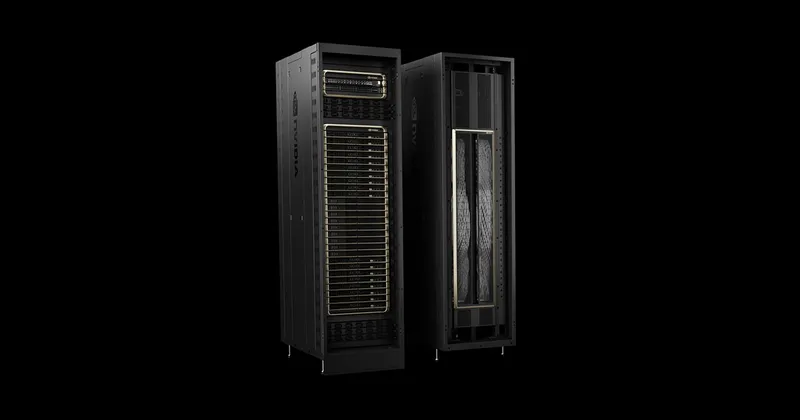
Image: NVIDIA GB200 NVL72 product page, used for editorial coverage of the reference Blackwell rack-scale system.
What it changes versus Hopper-class GPUs
Blackwell’s positioning is, on NVIDIA’s own framing, a generational step on three axes: training throughput on trillion-parameter models, inference throughput on the same models, and energy per token 2 . The exact multipliers NVIDIA quotes are workload-specific and benchmarked against H100 / H200 baselines, so independent third-party reproductions are still emerging. Treat NVIDIA’s marketing comparisons as the vendor’s framing, not as substitutes for your own benchmark.
For Indian teams already running on H100 or A100 instances, the practical question is whether the new generation justifies the rate per GPU-hour. If your workload is memory-bandwidth-bound or you’re training models that genuinely need the extra HBM capacity per GPU, Blackwell pays back. If your workload is inference on a 7B–70B model that already fits comfortably on an H100 or even L40S, the upgrade case is weaker.
India-specific GPU cloud options
Three categories of provider matter for an Indian AI team in 2026.
E2E Networks has been the most visible India-headquartered GPU cloud provider for several years and now lists Blackwell-class capacity on its GPU catalogue 3 . INR billing, GST invoicing, and Indian data-centre presence are the three operational reasons Indian teams gravitate to E2E. Verify the specific Blackwell SKU available, the data-centre region, and the current rate against E2E’s catalogue page before commit; Indian-provider pricing tends to be more dynamic than hyperscaler rate cards.
Yotta Data Services runs Shakti Cloud, a sovereign-AI GPU programme with substantial NVIDIA capacity announced under the IndiaAI mission 4 . Shakti targets enterprise and government workloads more than individual AI teams, but the on-demand and reserved tiers are open to commercial customers, and the data-residency posture is explicit.
The hyperscalers, including AWS P6 instances 5 , Google Cloud A4 and A4X virtual machines 6 , and Microsoft Azure ND GB200 v6 series 7 , all expose Blackwell GPUs through their standard API and console flows. Indian customers transact with the hyperscalers through their global entities, which means USD billing for most line items even when the data-centre region is in Mumbai or Hyderabad. NVIDIA DGX Cloud sits on top of all four (AWS, Microsoft Azure, Google Cloud, and Oracle Cloud Infrastructure — DGX Cloud first launched on OCI in March 2023, with AWS the most recent addition in late 2024) 8 , packaging Blackwell capacity with NVIDIA’s own software stack as a managed offering.

Image: E2E Networks GPU cloud catalogue, used for editorial coverage of the Indian-provider Blackwell rental option.
Pricing comparison and the INR billing question
Generalising on rates is risky because GPU pricing shifts faster than article-publish cadence. Two patterns hold consistently in 2026, though, and are worth naming.
First, Indian providers like E2E and Yotta tend to undercut hyperscaler list prices on equivalent GPU configurations, often meaningfully. The 30-40% number that gets quoted in industry chatter is workload-specific, not a fixed discount, and depends on whether you’re comparing on-demand, reserved, or spot rates. Verify against current rate cards before treating any specific percentage as load-bearing.
Second, hyperscaler ergonomics, including the IAM and identity stack, the managed object storage, the inference endpoints, and the observability tooling, bundle in a way that Indian-provider catalogues don’t always match yet. For a single training run on a fixed dataset, the price gap dominates. For a production inference workload that needs autoscaling, blue-green deploys, and tight integration with the rest of your cloud footprint, the hyperscaler bundle is often worth its premium.
INR billing matters for two reasons specific to India. GST input credit only flows through cleanly when the supplier is GST-registered in India, which Indian providers are by default and hyperscalers are through their Indian entities (with some line-item caveats). And forex exposure on USD-denominated GPU rentals is a real cost when the rupee is volatile; INR-denominated contracts cap that exposure at the contract boundary. Prices fluctuate — verify before purchase, and price your runs in both INR and USD before committing to a provider.
DPDP Act and the data-residency angle
The Digital Personal Data Protection Act, 2023 is now law in India, with operational rules being phased in through 2026 9 . The Act does not impose a blanket data-localisation mandate the way some earlier drafts proposed; instead, it gives the central government authority to notify specific countries to which transfers are restricted. For most current AI workloads, that means data-residency is a contractual and operational question rather than a statutory blocker.
Two practical implications for GPU rental decisions. If your training data includes personal data of Indian data principals, your data-protection officer will want a clear answer on where the data is stored, where the compute happens, and which jurisdiction the data-processor contract is governed by. Indian providers like E2E and Yotta give the cleanest answer to that question because the answer is “India” on every line. Hyperscalers can give a clean answer too, but it requires choosing the Indian region explicitly and reading the data-processing addendum carefully.
If your workload is training on synthetic data or on already-public datasets without personal data in scope, the DPDP question is largely moot and provider choice reduces to price, ergonomics, and SLA.
What to test before you commit
For training-class workloads, the comparison points are throughput per dollar on your specific model architecture and dataset, scale-out efficiency across multi-node configurations, and storage I/O bandwidth between the GPU instance and your dataset’s home. Run a small-scale benchmark on your actual model before signing a reserved contract; advertised TFLOPS numbers are not what you’ll see in practice.
For inference workloads, latency at your target token rate, cold-start time for autoscaling, and integration with your existing observability stack matter more than raw throughput. Test the full request path, not the GPU in isolation.
For both, ask the provider for a one-week trial budget. Indian providers are typically more flexible on this than hyperscalers, who’d rather you use their free-tier credits and graduate to paid plans on your own.
Honest caveats
We have not independently benchmarked Blackwell GPUs against Hopper-class GPUs on production workloads in 2026, and we don’t have access to fresh per-provider hourly rates as of the publication date for every SKU mentioned. The framing above reflects publicly-available vendor positioning, broad industry pricing patterns, and the structural questions that an Indian AI team should ask before committing to a provider. Concrete rate-card numbers are best fetched from each provider on the day you decide.
The Blackwell rollout is also still in motion. Some providers list Blackwell as “coming soon” or “limited availability” rather than as an open SKU; others have full general availability. Quota constraints on Blackwell capacity remain real on hyperscalers, particularly in non-US regions. Build a fallback plan with H200 or H100 capacity in case your preferred Blackwell SKU is unavailable when you need it.
Sources
How this article was made: an autonomous AI pipeline researched, drafted, fact-checked, and reviewed this piece, aggregating publicly-available information from the sources consulted below. AI (artificial intelligence) can make mistakes, so please cross-check the consulted sources before acting on anything here. Neural Tech Daily is not liable for decisions or outcomes based on this article.
Sources consulted
Cited Sources
- 1. NVIDIA — GB200 NVL72 product page (accessed ) ↩
- 2. NVIDIA — Blackwell architecture overview (accessed ) ↩
- 3. E2E Networks — GPU cloud catalogue (accessed ) ↩
- 4. Yotta — Shakti Cloud GPU offering (accessed ) ↩
- 5. AWS — EC2 P6 / Blackwell instances (accessed ) ↩
- 6. Google Cloud — A4 / A4X VMs powered by NVIDIA B200 (accessed ) ↩
- 7. Microsoft Azure — ND GB200 v6 series (accessed ) ↩
- 8. NVIDIA — DGX Cloud overview (accessed ) ↩
- 9. MeitY — Digital Personal Data Protection Act, 2023 (accessed ) ↩
Further Reading
- E2E Networks — homepage (accessed )
Anonymous · no cookies set