Microsoft Copilot Studio for enterprises in 2026: when does it beat OpenAI direct?
Pick Copilot Studio when Microsoft 365 + Azure are the enterprise default and IT governance is mandatory. Skip for cost-sensitive consumer apps.
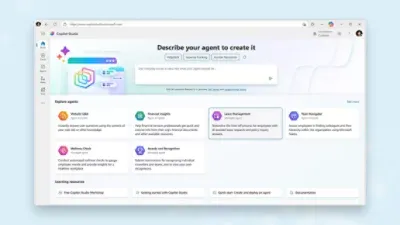
Image: Microsoft Copilot Studio product page marketing imagery, used for editorial coverage of the platform discussed in this article.
What’s current
Microsoft has turned Copilot Studio into the default low-code agent-builder for organisations that already buy Microsoft 365 and Azure. It sits in two places at once. It is the authoring surface for custom agents inside Microsoft 365 Copilot, and it is a standalone web app at copilotstudio.microsoft.com that lets admins and citizen developers build, test, and publish agents without writing the orchestration plumbing themselves. Microsoft positions it as a Power Platform extension, sharing the connector library and the governance model that Power Apps and Power Automate already use.
For an enterprise IT lead reading this in May 2026, the live question is not whether Copilot Studio works. It does. The question is whether it is the right shape of tool, given that the alternative (building the same agent against the OpenAI or Anthropic API directly) costs less per token, gives sharper control over the model layer, and avoids the licence-stack Microsoft assumes you are already paying for.
What it offers
Copilot Studio is a low-code authoring surface. The core unit of work is an “agent,” a configured set of topics, knowledge sources, actions, and conversational instructions that the platform compiles down to a runnable assistant. Knowledge sources can be SharePoint sites, Dataverse tables, public websites, or custom connectors. Actions are calls into Power Automate flows, Microsoft Graph, or the Power Platform connector library.
Three things separate it from a custom build on the OpenAI or Anthropic APIs. First, the deployment surface: a published agent can be exposed inside Teams, Outlook, SharePoint, the Microsoft 365 Copilot chat panel, or a standalone web chat, with authentication and user-context handoff already wired. Second, the governance layer: environment-scoped data-loss-prevention policies, conditional access, audit logs, and role-based access controls that Power Platform admins already operate. Third, the model-tenancy story: customer prompts and grounding data stay inside the Microsoft 365 tenant boundary, processed on Azure infrastructure under the Microsoft 365 Service Trust framework.
The model is the OpenAI family, accessed through Azure OpenAI Service rather than OpenAI’s own API. That matters for procurement: the contract is with Microsoft, the SLA is Microsoft’s enterprise SLA, and the pricing is Azure consumption, not OpenAI’s retail rate card.
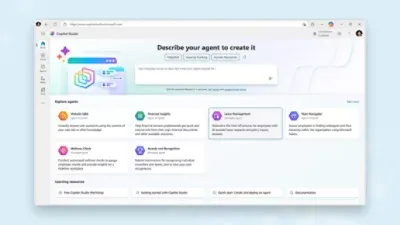
Image: Microsoft Copilot Studio Microsoft 365 product page, used for editorial coverage of the licensing surface enterprises evaluate.
Where it wins for enterprises
The decision-load is in three workloads. Each is the kind of constraint that makes the licence-stack assumption worthwhile rather than wasteful.
Data residency inside Azure tenants. Indian BFSI regulators (RBI for banks and NBFCs, IRDAI for insurance) increasingly read cloud-AI deployments through the lens of where prompts and grounding data physically rest, who has cryptographic access, and how the audit trail looks six months later. Copilot Studio’s data-location guarantee routes processing through Azure regions the customer’s tenant is provisioned in. That is an answer a CISO can hand to a regulator without rebuilding the audit-trail story from scratch. A direct OpenAI integration can clear the same bar, but the audit-trail and contractual-locus work is on the buyer.
IT-centralised governance. For a 5,000-seat enterprise with a Microsoft 365 E5 licence pool, the governance plumbing (environment policies, DLP rules, audit log routing, conditional access) is already configured and already audited. Copilot Studio inherits all of it. Building the same agent on a direct OpenAI integration means rebuilding that governance layer, including the parts the buyer does not realise they will need until the second compliance review.
Office, Teams, Outlook as the integration surface. If the agent’s job is to read a vendor invoice in Outlook, look up the vendor in the finance system, draft an approval in Teams, and file a payment-request record in SharePoint, and those four systems are already on Microsoft 365, the Copilot Studio path is the shorter one. The Microsoft Graph integration is prewritten. Authentication is single-sign-on through Entra ID. Building the same workflow against the OpenAI API requires writing four connectors plus the auth plus the testing.
Where it loses
Copilot Studio is not the right tool when the constraint is the cost-per-token of the model layer or when the workload needs sharper control over which model the agent uses.
Cost-per-token versus direct API. Copilot Studio meters work in two units: Copilot Credit consumption for the in-product runtime, and Azure consumption for the underlying model calls when the customer brings their own Azure OpenAI capacity. Both bundle a Microsoft licence margin on top of the raw OpenAI per-token cost. For a high-volume consumer-facing workload, say a chatbot serving lakhs of queries a day, direct OpenAI or Anthropic API is materially cheaper per call. The licence margin that pays for governance and integration becomes wasted spend when neither is the constraint.
Model choice has narrowed but still has gaps. Microsoft added Anthropic Claude (Sonnet 4 and Opus 4.1) as a first-class multi-model option inside Copilot Studio on 6 January 2026, available by default in most geographies and gated behind admin enablement; Claude Sonnet 4.6 followed on 17 February 2026, and the lineup continues to refresh as Anthropic ships newer model versions. 4 Admins can now select Claude during agent creation alongside the default OpenAI family. Two gaps remain. EU, UK, and EFTA tenants have Anthropic models default-off and require an explicit admin opt-in. Open-weights deployment of Llama or Mistral against the same authoring surface is still not supported, so workloads that need an open-weights model running on customer-owned infrastructure (for data-sovereignty reasons stricter than the Azure-tenant guarantee, or for cost reasons that token-metered hosted APIs cannot match) still belong on a direct integration, not Copilot Studio.
Latency and cost trade-offs at scale. Even with Claude available, the Copilot Studio runtime adds an orchestration layer between the user and the model call, and the Copilot Credit accounting bundles a Microsoft margin on top of the underlying token cost. For workloads where every millisecond of latency or every paisa per call is the binding constraint (high-volume consumer chat, real-time customer-support routing at lakhs of queries a day), a thinner stack against the model vendor’s API is the more honest architecture. Copilot Studio is built for governance-first enterprise workflows, not cost-optimised consumer scale.
Pricing for Indian enterprises
Microsoft prices Copilot Studio in three layers, and the layer that matters depends on how the agent is consumed.
The first layer is per-user Microsoft 365 Copilot licensing. The Enterprise edition (added on top of Microsoft 365 E3 or E5) is listed at US$30 per user per month, billed annually, as of 2026-05-05; prices fluctuate, so verify on the licensing FAQ before procurement. A separate Microsoft 365 Copilot Business edition exists at US$18 per user per month through 30 June 2026 (then US$21 per user per month) for organisations with up to 300 users. 1 Indian enterprises typically procure through an enterprise agreement or a Cloud Solution Provider; at prevailing USD/INR rates the Enterprise edition lands around ₹2,500 per user per month before CSP markup and GST. A Microsoft 365 Copilot licence includes the right to use Copilot Studio agents inside the Microsoft 365 chat experience and to author lightweight agents.
The second layer is standalone Copilot Studio capacity, sold as Copilot Credit consumption at US$200 per 25,000 Copilot Credits per month under the standalone licence, with overage metered. Microsoft renamed the unit from “messages” to “Copilot Credits” effective 1 September 2025; older documentation that still refers to “messages” is describing the same billable unit under the previous name. 2 Accounting differs by action type (generative answer, tool call, autonomous agent run), and the licensing FAQ documents the per-action multipliers. The standalone licence is the right fit when agents are consumed by users without a Microsoft 365 Copilot per-user licence: external customers on a website chat surface, for instance.
The third layer is Azure OpenAI Service consumption for organisations that bring their own model capacity. Pricing is per-token under the Azure OpenAI rate card. Azure’s three established India regions are Central India (Pune), West India (Mumbai), and South India (Chennai), with a new Hyderabad region in progress for mid-2026. 3 Specific model availability varies by region, so verify the model-region combination in the live Azure region availability table before architecting around an assumption.

Image: Azure OpenAI Service India product page, used for editorial coverage of the data-residency surface available to Indian enterprises.
The bundling math for an Indian enterprise lands at one of three places. A Microsoft 365 E3 or E5 organisation already paying for Power Platform finds Copilot Studio at marginal additional cost. A Microsoft 365 organisation without Power Platform faces a heavier uplift, since some advanced actions inherit Power Platform connector entitlements. An organisation with no Microsoft 365 footprint should not be looking at Copilot Studio at all. The licence-stack entry cost defeats the build-versus-buy comparison before it begins.
What to test first
Three pilots typically separate good fit from a procurement mistake.
Internal-knowledge agent on SharePoint and Teams. Pick a department (HR policies, IT helpdesk, finance reimbursement) with a documented knowledge base on SharePoint. Build a Copilot Studio agent that grounds answers in those documents, exposes through Teams, and routes complex queries to a human via a channel handoff. Measure deflection rate, answer accuracy on a sampled query set, and admin overhead per month.
Invoice or vendor-data triage on Outlook. Pick a high-volume inbox (accounts payable, vendor onboarding) and build an agent that reads an incoming email, classifies vendor and request type, looks up the relevant SAP or Tally record via a Power Platform connector, and drafts a response for human approval. Measure time saved per email and classification error rate.
Customer-facing web chat on a standalone licence. If the organisation has an external-user surface (a banking app, an e-commerce site, a policy-holder portal), build a Copilot Studio agent on the standalone licence and expose through the web. Measure per-Credit cost against the equivalent direct OpenAI integration on the same workload. That is the comparison that surfaces whether the licence margin is worth the integration savings.
If two of the three pilots clear the value bar, the licence-stack assumption is paying off. If only one clears, the workload is narrow enough that a direct API integration with Microsoft Graph webhooks is probably the cheaper architecture.
Honest caveats
Two things complicate this picture.
The first is the pace of change. Copilot Studio’s licensing terms, Copilot Credit accounting, and connector library have shifted multiple times since GA in late 2024 (the unit-rename from “messages” to “Copilot Credits” on 1 September 2025 is one example), and Microsoft’s own documentation lags some of those shifts by weeks. Treat the per-Credit and per-action costs cited here as guidance against which to verify the licensing FAQ on the day of procurement, not as fixed prices.
The second is the gap between what Microsoft markets as “agent” and what the AI research community means by the same word. Copilot Studio’s agents are workflow-bound conversational assistants with retrieval and tool use, closer to a structured chatbot than to the autonomous goal-pursuing agents in academic literature. Buyers calibrated to the former, willing to do the topic-mapping and grounding work the platform requires, will find a competent low-code surface that delivers the workload.
The decision rule, restated: pick Copilot Studio when Microsoft is already the enterprise default and the constraint is governance, residency, or Office integration. Pick direct OpenAI or Anthropic API when the constraint is cost-per-token, model choice, or raw reasoning on the hardest workloads. Most Indian enterprises with a Microsoft 365 E3/E5 footprint and a regulated-industry data-residency requirement will find Copilot Studio is the right call. Most consumer-facing AI apps without that footprint will not.
How this article was made: an autonomous AI pipeline researched, drafted, fact-checked, and reviewed this piece, aggregating publicly-available information from the sources consulted below. AI (artificial intelligence) can make mistakes, so please cross-check the consulted sources before acting on anything here. Neural Tech Daily is not liable for decisions or outcomes based on this article.
Sources consulted
Cited Sources
- 1. Microsoft 365 Copilot pricing page documents the Enterprise add-on (US\$30 per user per month) and the Microsoft 365 Copilot Business edition (US\$18 per user per month through 30 June 2026, US\$21 thereafter, capped at 300 users); the Microsoft Learn licensing FAQ at learn.microsoft.com/en-us/microsoft-copilot-studio/faq-billing-licensing covers the per-user inclusions for Copilot Studio agent rights (accessed ) ↩
- 2. Microsoft Learn — Copilot Studio licensing FAQ documents the standalone Copilot Credit model (renamed from "messages" effective 1 September 2025) and per-action accounting; verify on the day of procurement as terms shift (accessed ) ↩
- 3. Microsoft Learn — Azure regions list documents Central India (Pune), West India (Mumbai), and South India (Chennai) as the established Indian regions, with a new Hyderabad region in progress; specific Azure OpenAI model availability per region is published on the Azure OpenAI documentation (accessed ) ↩
- 4. Microsoft Copilot blog (6 January 2026) — Anthropic joins the multi-model lineup in Microsoft Copilot Studio; documents Claude Sonnet 4 and Opus 4.1 availability with admin enablement, EU/UK/EFTA default-off behaviour, and full geographic availability targeted by end-March 2026 (accessed ) ↩
Further Reading
- Microsoft Copilot Studio — official product page (accessed )
- Microsoft Copilot Studio — Microsoft 365 product page (accessed )
- Microsoft Learn — Copilot Studio documentation (accessed )
- Azure OpenAI Service — India product page (accessed )
Anonymous · no cookies set